Does Fiber Laser Processing Require Operator Safety Training?
Author
Date Published
Reading Time
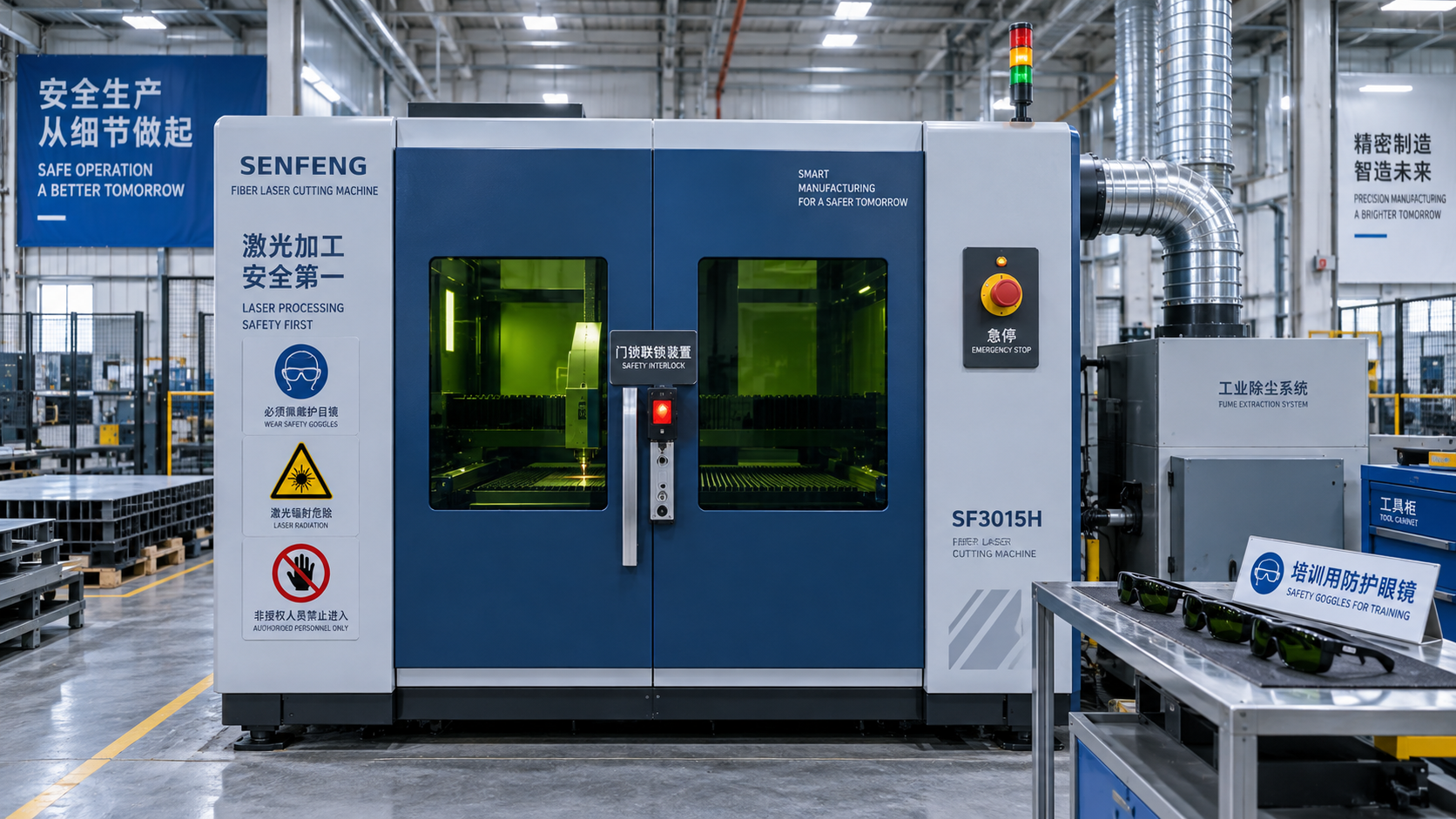
Does Fiber Laser Processing Require Operator Safety Training?
Does laser processing require operator safety training? Yes—safe fiber laser operation depends on training matched to the equipment, exposure risks, and applicable regulations. Even enclosed systems require operators to understand interlocks, emergency procedures, and the hazards introduced during setup or maintenance. Invisible near-infrared radiation, reflected beams, process fumes, and fire risks make training an operational safeguard, not merely an administrative exercise.
The practical question is not whether training belongs in a fiber laser program. It is what each person must know before being authorized to perform a particular task. Running an enclosed cutting machine, changing a welding fixture, and servicing an exposed beam path are different activities. Treating them as one training category leaves gaps precisely where working conditions change.
An enclosed machine does not eliminate the need for training
Many industrial fiber laser systems contain a high-power laser inside a protective enclosure. A machine may be classified as Class 1 for normal operation because accessible laser emission remains within the relevant limits, while its embedded source is Class 4. Those descriptions are not contradictory: one concerns accessible emission from the complete product under specified conditions; the other describes the source hazard.
Operators of an appropriately enclosed system generally do not need the same laser-specific precautions as personnel working around an accessible Class 4 beam. They still need to recognize damaged guards, abnormal interlock behavior, unsuitable viewing windows, and tasks outside their authorization. A classification label is not permission to open protective panels or improvise a recovery procedure.
Handheld laser welding requires separate scrutiny. Where the beam or hazardous reflections can be accessible, the risk assessment must address the surrounding work area, adjacent personnel, access control, and beam containment. Welding experience with conventional arc equipment does not automatically establish competence for this work.
A useful training boundary is simple: routine operators must know what they can do, what they must stop doing, and whom to call when a task would compromise a protective measure.
The hazards extend beyond the beam
Many industrial fiber lasers operate in the near-infrared region, commonly around 1 µm, although the actual wavelength must be checked in the equipment documentation. This radiation is invisible and can present a severe eye hazard. A visible aiming light does not reveal the processing beam’s intensity or establish that an area is safe.
Reflections also matter. Workpiece material, surface finish, angle, and geometry influence where reflected energy travels. A fixture or part change can therefore alter the exposure conditions even when the programmed power remains unchanged. At sufficiently high powers, diffuse reflections may also be hazardous; “not mirror-like” is not a reliable safety judgment.
Training must connect these optical hazards with the process hazards operators encounter daily:
- Airborne contaminants: Fume composition depends on the base material, coatings, contamination, and process. Extraction must suit those emissions, rather than merely remove visible smoke.
- Fire and hot material: Sparks, molten particles, hot parts, and accumulated debris can ignite nearby combustibles or deposits in collection equipment.
- Machine movement: Automated tables, robots, clamps, and material-handling equipment introduce crushing and collision hazards.
- Utilities and stored energy: Electrical systems, pressurized gases, and other energy sources require task-specific isolation procedures during relevant maintenance work.
This is why laser safety training cannot be reduced to a presentation about protective eyewear. It must explain the complete work cell and the conditions under which production should stop.
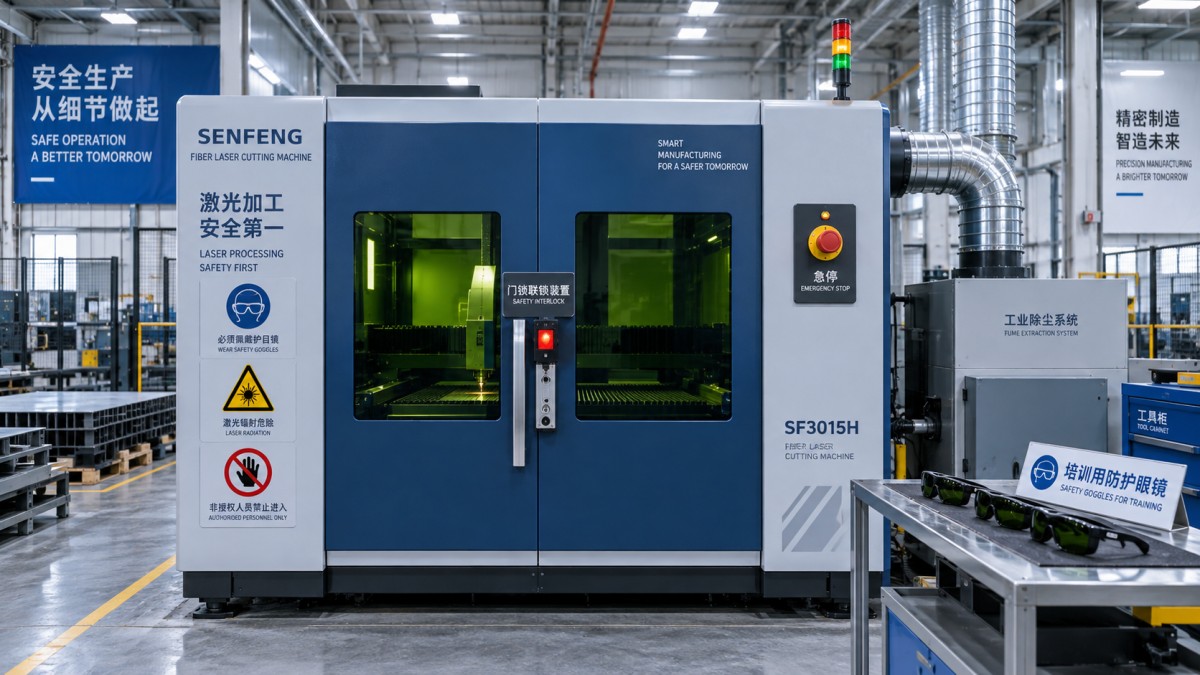
What standards establish—and what they do not
There is no single worldwide training certificate that automatically authorizes every fiber laser task. Legal duties depend on the jurisdiction, workplace, equipment configuration, and exposure conditions. Employers should verify local occupational safety requirements rather than assume that a supplier’s handover session satisfies every obligation.
Several standards provide useful reference points. IEC 60825-1 addresses laser product classification and requirements. ISO 11553-1 addresses laser safety requirements for laser processing machines. In the United States, ANSI Z136.1 provides a framework for safe laser use, while ANSI Z136.9 focuses on manufacturing environments. Their scope and applicable editions should be checked against the installation.
These documents are not interchangeable. Product classification does not demonstrate operator competence, and workplace training does not compensate for an inadequate enclosure. Standards may be voluntary references, contract requirements, or incorporated into legal obligations; their status needs jurisdiction-specific review.
Likewise, a machine conformity declaration, where applicable, is not evidence that the employer has completed its workplace assessment. Integration with a robot, modifications to access points, or changes to the process may require further evaluation. Where accessible high-hazard emission is possible, determine whether a designated laser safety officer or equivalent competent person is required by the applicable framework.
Match competence to the work people actually perform
A workable training program separates awareness, routine operation, setup, and specialist intervention. Not everyone needs to calculate exposure limits. Everyone who could encounter the hazard needs to understand relevant access restrictions and warning signals.
Protective eyewear deserves particular attention wherever the assessment calls for it. Selection depends on wavelength, required optical density, exposure conditions, and applicable performance requirements. Lens color or a generic “laser glasses” label is not enough. Eyewear is a supplementary control, not a substitute for containment, and ordinary welding protection should not be assumed suitable for the laser wavelength.
Training should also explain the difference between an emergency stop and energy isolation. An emergency stop does not necessarily make a machine safe for maintenance. Operators must follow the site’s approved procedures rather than infer safety from a stationary machine or dark display.
Demonstrated competence matters more than attendance
A signed attendance sheet confirms that someone attended a session. It does not establish that they can respond correctly to a fault. Practical assessment should use the actual machine, approved demonstrations, or simulations that do not create exposure.
Ask the operator to identify a damaged protective window, explain the response to an extraction alarm, or describe what happens when a part jams. The critical test is whether the person recognizes the limit of their authorization. “I would stop and escalate” can be the correct answer, particularly when recovery would require entering a guarded area.
Emergency training should cover suspected eye exposure even when there is no immediate pain, smoke or fire, and abnormal equipment behavior. It should identify how to stop work safely, alert others, and obtain prompt medical evaluation where exposure is suspected. Incident investigation belongs with competent personnel; operators should not restart the process simply to reproduce the fault.
Records should identify the equipment and tasks covered, assessment outcome, restrictions, and authorization date. Refresher timing should follow applicable requirements and the site’s risk assessment. Equipment changes, new materials, incidents, extended absence, or observed unsafe behavior can justify retraining before the scheduled review.
Build training into equipment handover
Training gaps often begin before production starts. A supplier may teach programming and routine operation while the purchaser assumes that laser hazard assessment, extraction arrangements, and contractor access are included. Those responsibilities should be resolved during specification and handover, not after installation.
Request documentation covering classification, embedded source characteristics, protective measures, intended operating modes, maintenance boundaries, and residual risks. Confirm which activities supplier training covers and which require additional site-specific instruction. For an integrated cell, establish who assesses the completed assembly rather than only its individual components.
The Global Energy-Beam & Thermal-Processing (G-EBT) benchmarking perspective is useful here: compare equipment capability with the operating protocols needed to use it safely. Across laser processing, beam equipment, thermal treatment, joining, and plasma processing, hardware specifications alone do not establish readiness. For a fiber laser installation, the assessment should connect beam parameters, safeguards, process emissions, and operator competence.
Before authorizing production, confirm three things: the installed configuration has been assessed, each task has a defined authorization boundary, and personnel can demonstrate the required response when conditions depart from normal. If any of those remains unclear, the next step is to resolve the gap—not to rely on the enclosure label or a generic training certificate.
Expert Insights

Chief Security Architect
Dr. Thorne specializes in the intersection of structural engineering and digital resilience. He has advised three G7 governments on industrial infrastructure security.
Related Analysis
- Nov 01, 2026Choosing a Biosafety Cabinet for Microbiology: Class I, II, or III?Author :Dr. Aris Nano
- Oct 31, 2026Pallet Truck Scale Prices: What Affects the Cost of a Weighing Pallet Jack?Author :Dr. Aris Nano
- Oct 30, 2026How to Use a Concrete Test Hammer to Assess Concrete StrengthAuthor :Dr. Aris Nano
Recommended News
- Choosing a Biosafety Cabinet for Microbiology: Class I, II, or III?Author :Dr. Aris Nano

- Pallet Truck Scale Prices: What Affects the Cost of a Weighing Pallet Jack?Author :Dr. Aris Nano

- How to Use a Concrete Test Hammer to Assess Concrete StrengthAuthor :Dr. Aris Nano

- Metal Joining Services in Southeast Asia: How to Qualify SuppliersAuthor :Marcus Valve