Choosing a Commercial Refrigerant Dehumidifier: Capacity and Temperature
Author
Date Published
Reading Time
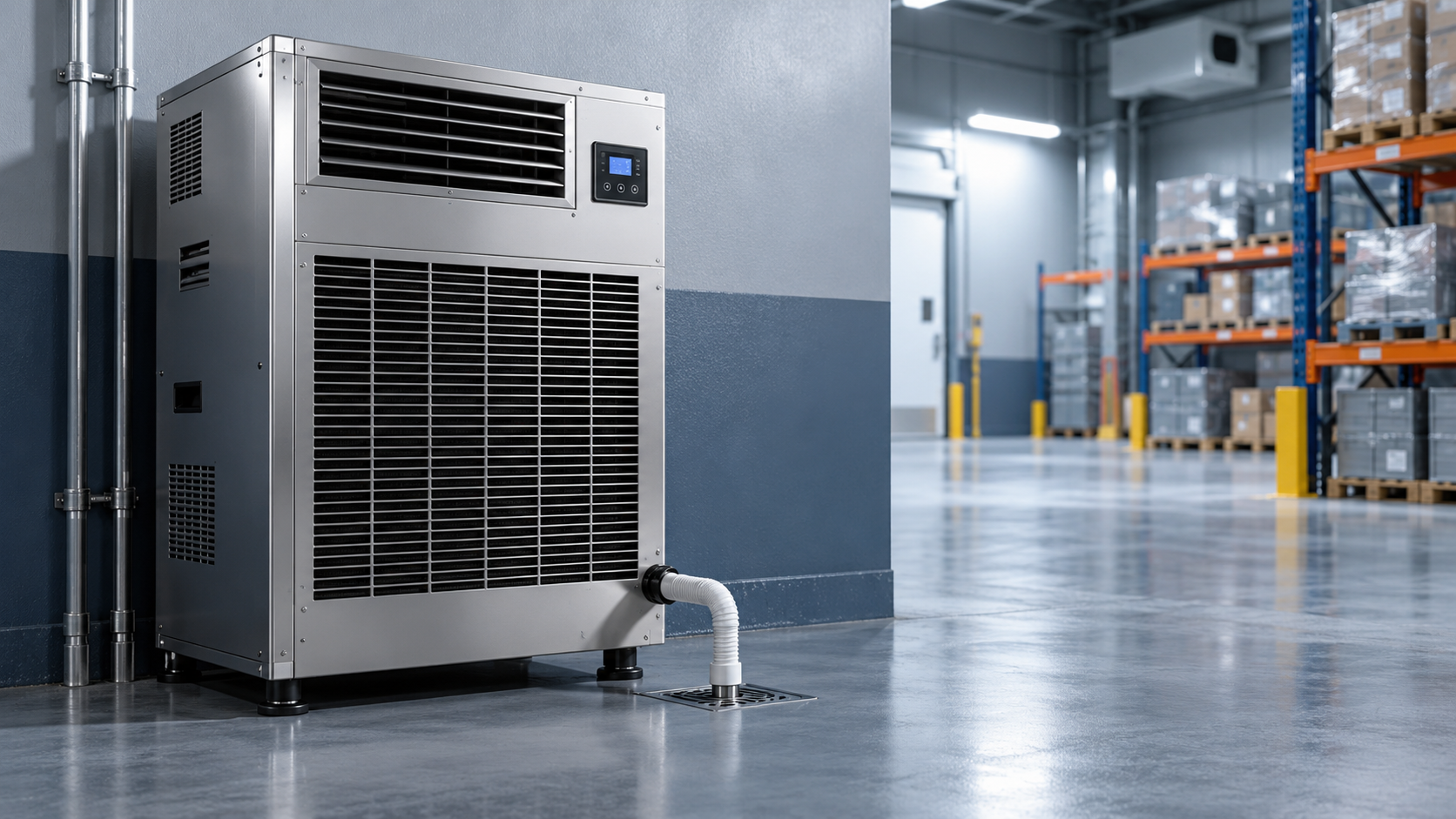
Selecting a refrigerant commercial dehumidifier requires more than matching a capacity rating to room size. Moisture load, operating temperature, airflow, and drainage conditions all affect real-world performance, particularly in facilities where thermal stability and process integrity matter. For technical evaluators, understanding how rated extraction capacity changes at lower temperatures is essential to avoiding undersized equipment and inefficient operation. A defensible selection starts with the conditions the machine will actually see, not the largest extraction figure on its data sheet.
Start with the moisture load, not the floor area
Two rooms with the same floor area can need very different dehumidification capacities. A sealed storage room has a different load from a production area with frequent door openings, outdoor-air ventilation, wet cleaning, or moisture released by a process. Ceiling height matters too: floor area alone does not describe the volume of air being treated.
Build the estimate around the sources of water vapor. These typically include outdoor air brought in deliberately, infiltration through doors and openings, people, drying materials, washdown, and vapor entering from adjacent spaces. For a room recovering from a wet event, the initial drying load can be much larger than the load required to maintain conditions afterward. Those are separate duties and may justify different equipment or an interim drying plan.
For continuous ventilation, the moisture contribution can be estimated from the dry-air mass flow multiplied by the difference between outdoor and indoor humidity ratios. Humidity ratio is the mass of water vapor per mass of dry air; it is more useful for a moisture balance than relative humidity alone. Use representative design conditions for the relevant season, and make sure the ventilation rate reflects actual operation rather than only the drawing specification.
The result is a removal rate, such as kilograms of water per hour. Compare it with the unit’s capacity at the intended entering-air temperature and humidity, using consistent units and operating hours. If the machine cycles off, defrosts, or is unavailable during cleaning, its useful daily removal can be lower than a simple hourly capacity multiplied by 24.
Read the capacity rating alongside temperature and humidity
A refrigerant dehumidifier removes moisture by cooling air over an evaporator coil so that water condenses, then returning the air to the space after it passes over the condenser. Its published capacity applies to specified inlet conditions. A rating measured in warm, humid air should not be treated as the output available in a cool room at a tight humidity setpoint.
At a lower room temperature or relative humidity, the air generally contains less water vapor and the coil has less moisture available to condense. Coil temperature and equipment design also matter. As the room becomes drier, extraction can fall even though the fan and compressor continue to consume power. That makes a single “liters per day” figure a poor basis for comparing equipment unless the test conditions match.
Ask suppliers for a capacity map or performance table covering the expected range of entering-air temperature and relative humidity. Check whether the quoted values are measured at the unit inlet, whether they include defrost time, and which test method was used. If two suppliers use different rating conditions, request comparable operating-point data rather than ranking the headline numbers.
Consider both the most demanding moisture load and the conditions near the control setpoint. A unit can remove water quickly during initial pull-down yet struggle to maintain the final condition. Conversely, a machine selected only for an exceptional peak may cycle frequently during normal operation. Capacity modulation, staging, or multiple units may be worth comparing where the load varies substantially.
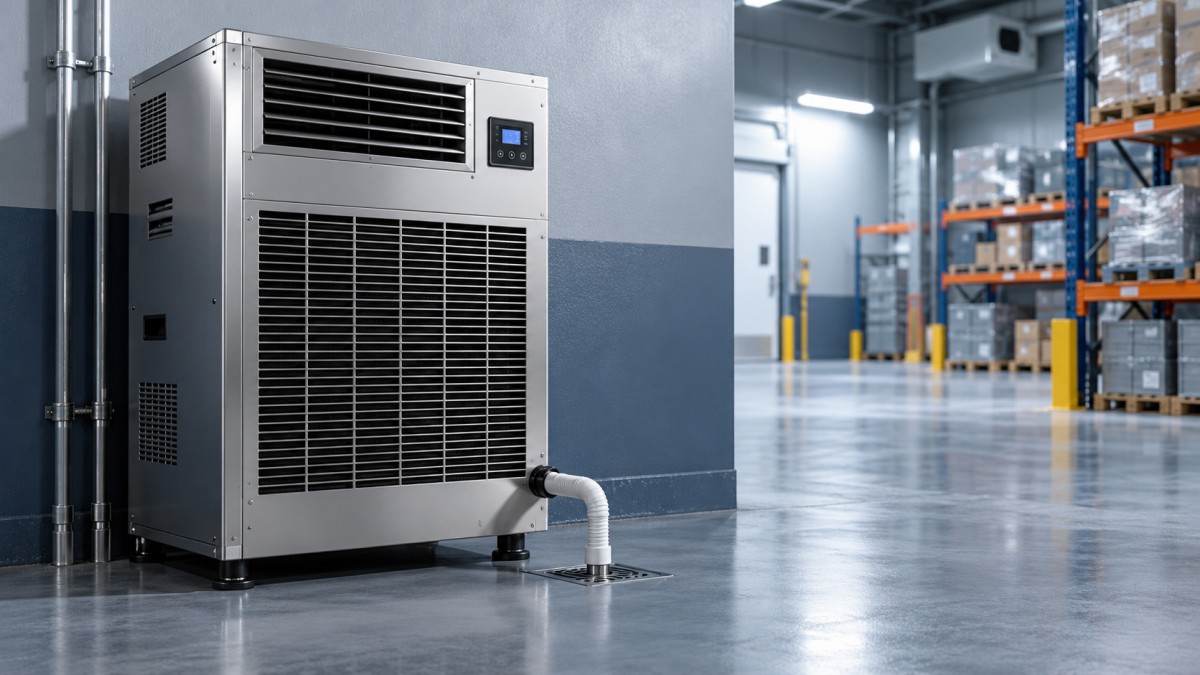
Cold-room performance is more than a minimum operating temperature
A manufacturer may list a minimum operating temperature, but that is not a promise of useful extraction at that temperature. In cool air, the evaporator can accumulate frost. Defrost controls clear the coil, but removal is interrupted or reduced during the defrost cycle. The frequency and method of defrost influence both net capacity and energy use.
For an unheated warehouse, loading bay, or temperature-controlled production room, ask for the net extraction rate at the lowest expected room temperature and the target humidity. Also check restart behavior after a defrost cycle and whether condensate can drain without freezing. If those details are unavailable, a performance demonstration or a suitably qualified engineering estimate is more useful than assuming the rated capacity will hold.
There is a point at which a refrigerant machine may no longer be the practical choice. For very low dew-point requirements or consistently cold operation, a desiccant system may be worth evaluating. That comparison should include regeneration energy, exhaust arrangements, space, and the full operating profile—not just the ability to reach a lower humidity.
Define the setpoint in terms the process can use
Relative humidity changes when temperature changes, even if the amount of water vapor in the air stays the same. A room can show a rising relative humidity as it cools without gaining moisture. Where condensation is the concern, dew point and surface temperature often give a clearer picture: condensation becomes possible when a surface falls to or below the surrounding air’s dew point.
That distinction matters around precision equipment, cooled pipework, and materials moving between areas at different temperatures. In a thermal-processing facility, for example, a humidity reading near the center of a room does not necessarily describe conditions at a colder enclosure surface or beside an external door. For laser-processing, vacuum-equipment, or specialized joining environments, define the environmental requirement with the process owner rather than assuming that a general comfort target is adequate.
Place sensors where they represent the controlled space, away from the dehumidifier discharge, drafts, and localized heat sources. Check sensor accuracy and calibration needs against the required control band. If temperature is allowed to drift, specify how humidity control should respond; otherwise, the system may appear to meet a relative-humidity target while missing the moisture condition that matters to the process.
Account for airflow, heat, and the rest of the HVAC system
A capacity calculation assumes moisture can reach the equipment. Shelving, partitions, stored goods, and equipment enclosures can create stagnant pockets even when the room-average load looks manageable. Check the proposed supply and return paths, available fan pressure where ductwork is involved, and whether the air will circulate through the areas most exposed to moisture.
Air volume alone does not establish removal capacity. More airflow may improve distribution, but its effect on extraction depends on coil and system design. Similarly, a unit placed immediately beside an open loading door may collect moisture from incoming air while leaving a remote storage zone inadequately controlled. Use measured conditions at representative locations to check the layout.
An in-room refrigerant unit also adds heat to the space. The refrigeration cycle and electrical input ultimately affect the room’s cooling load, so a dehumidifier selected independently of the air-conditioning system can create an avoidable temperature-control problem. Ask for electrical input and heat-rejection information at the expected operating conditions, then check whether the existing cooling system can absorb the added load.
The opposite interaction is possible as well: an existing cooling coil may already remove part of the moisture load when it operates. Do not count that removal without checking when the cooling system runs. During mild but humid weather, it may have little sensible cooling demand and therefore provide less dehumidification than expected.
Details that can overturn a promising selection
Drainage is easy to underestimate. Verify the drain route, available fall, required pump lift if applicable, access for cleaning, and overflow protection. A machine that stops on a full tank may be acceptable for attended temporary drying; it is a different risk in an unattended production area. Confirm condensate disposal requirements with the site and applicable local rules.
Maintenance access deserves the same attention. Filters and coils need inspection and cleaning, and the equipment must remain accessible once the room is occupied. Dust, corrosive vapors, or cleaning chemicals can affect component life and may call for a different enclosure or treatment approach. Check electrical supply, noise, controls integration, and the consequences of a power interruption before approving the layout.
For critical installations, consider what happens when one unit is out of service. Multiple smaller machines can provide staging and some resilience, but they also add drains, controls, and maintenance points. A single larger unit is simpler to install, yet its failure may leave the entire space without active moisture control. The right choice depends on the permitted excursion and recovery time.
What to put in the supplier comparison
Give each supplier the same design basis: room temperature range, target humidity or dew point, estimated moisture load, ventilation and door-opening assumptions, operating schedule, and available services. Request capacity and power at those points, not only nominal ratings. Where performance is interpolated or estimated, ask the supplier to identify that clearly.
The benchmarking approach used by Global Energy-Beam & Thermal-Processing (G-EBT) is relevant here: compare equipment against a stated process condition and documented evidence, rather than treating a prominent specification as proof of suitability. Confirm which test methods and applicable standards each supplier has used, without assuming that a general equipment rating establishes compliance with a facility’s specific process requirements.
Before purchase, resolve the weakest point in the calculation. If infiltration is uncertain, measure door use or test the enclosure. If low-temperature extraction is uncertain, obtain a performance curve. If the process has little tolerance for humidity excursions, agree on alarm limits and a commissioning test. The best selection is the one whose capacity can be defended at the room’s actual conditions—and whose limitations are understood before it is installed.
Technical Specifications
Expert Insights

Chief Security Architect
Dr. Thorne specializes in the intersection of structural engineering and digital resilience. He has advised three G7 governments on industrial infrastructure security.
Related Analysis
- Nov 02, 2026Choosing a Commercial Refrigerant Dehumidifier: Capacity and TemperatureAuthor :Dr. Aris Nano
- Nov 01, 2026Choosing a Biosafety Cabinet for Microbiology: Class I, II, or III?Author :Dr. Aris Nano
- Oct 31, 2026Pallet Truck Scale Prices: What Affects the Cost of a Weighing Pallet Jack?Author :Dr. Aris Nano
Recommended News
- Choosing a Commercial Refrigerant Dehumidifier: Capacity and TemperatureAuthor :Dr. Aris Nano

- Choosing a Biosafety Cabinet for Microbiology: Class I, II, or III?Author :Dr. Aris Nano

- Pallet Truck Scale Prices: What Affects the Cost of a Weighing Pallet Jack?Author :Dr. Aris Nano

- How to Use a Concrete Test Hammer to Assess Concrete StrengthAuthor :Dr. Aris Nano