How Often Should Industrial Plasma Cleaning Equipment Be Maintained?
Author
Date Published
Reading Time
How Often Should Industrial Plasma Cleaning Equipment Be Maintained?
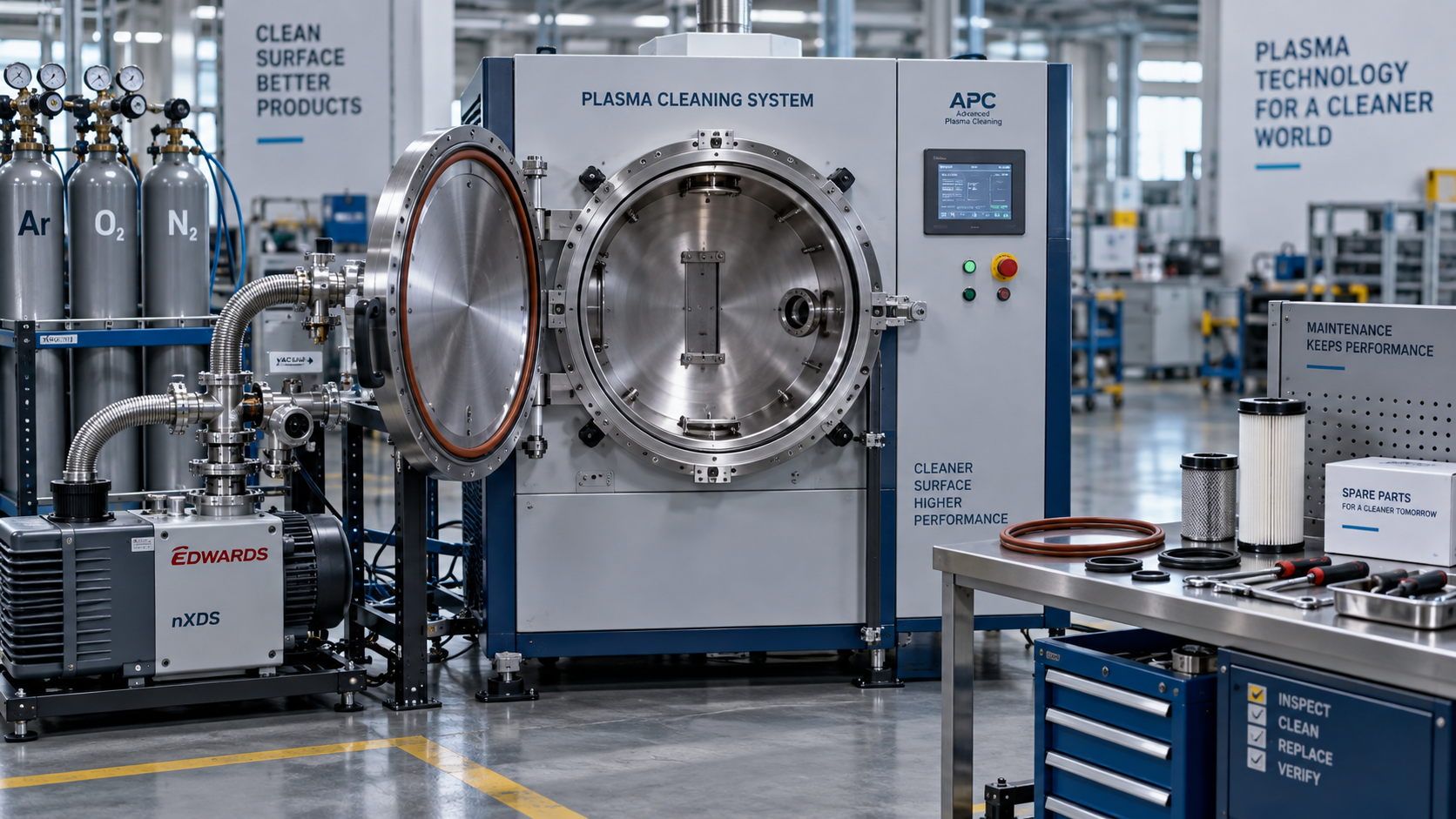
How often should industrial plasma equipment be maintained? Routine operating checks should generally happen each shift or production day, while cleaning, component servicing, and replacement intervals must follow the manufacturer’s instructions and actual process conditions. There is no reliable universal rule such as “service every six months” for every plasma cleaner.
Operating hours matter, but so do process chemistry, contamination load, and whether the system uses vacuum or atmospheric-pressure plasma. A lightly loaded chamber treating clean components has different maintenance demands from an atmospheric plasma head running continuously beside a dusty conveyor.
The practical approach is to combine a calendar-based inspection schedule with operating-hour limits and condition-based triggers. That protects surface-treatment consistency without opening equipment unnecessarily or replacing usable components simply because a date has arrived.
What is a sensible starting maintenance schedule?
Start with the equipment manual, including separate instructions for the plasma source, generator, vacuum pump, cooling unit, and gas supply. These subsystems may have different service intervals. Where the manufacturer specifies operating-hour limits, a busy production line can reach them well before its annual shutdown.
The schedule below is a planning framework, not a substitute for those requirements. It separates frequent observation from intrusive maintenance—a distinction that matters when opening a clean system can itself introduce contamination.
Do not turn every inspection into a replacement task. A daily check may take only a brief review of trends and external condition. Electrode replacement, pump servicing, and electrical work belong on a separate, controlled maintenance plan.
Why do vacuum and atmospheric systems need different attention?
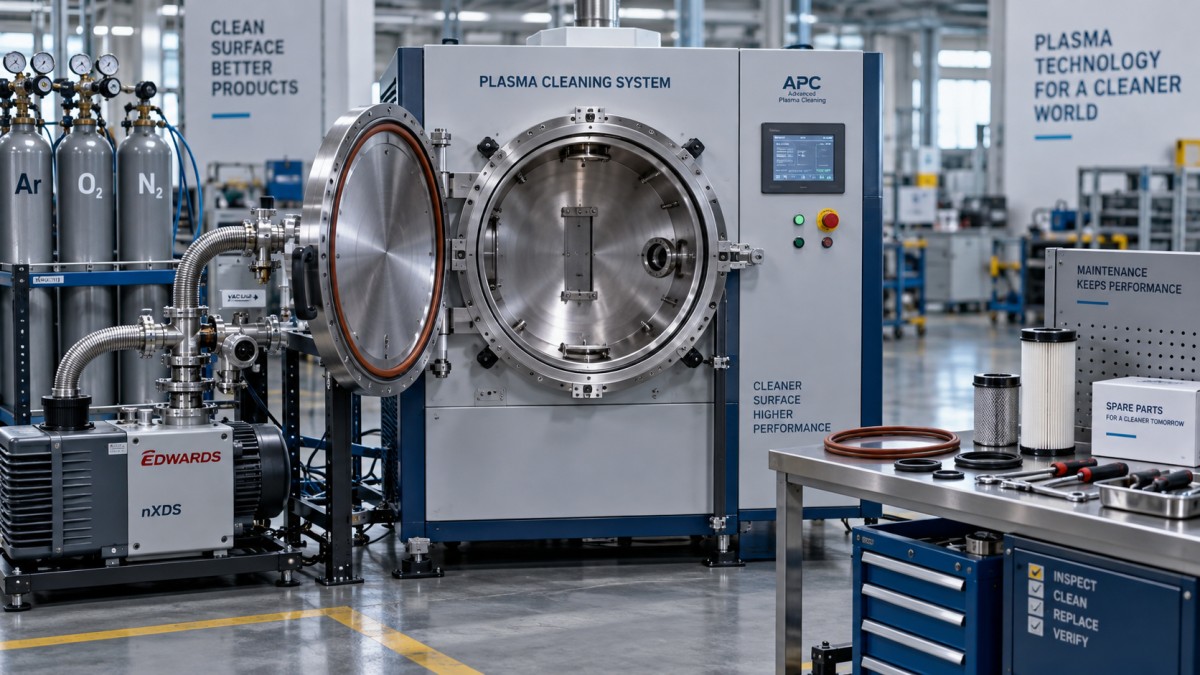
Vacuum plasma cleaners: watch the chamber and pumping system together
A vacuum system depends on more than the plasma source. Chamber deposits, contaminated seals, restricted pumping paths, and deteriorating pump performance can all change the conditions in which treatment occurs.
Track pump-down time under comparable conditions: the same load, similar chamber temperature, and the same pressure target. A persistent increase deserves investigation, but it does not automatically mean the pump needs replacement. A dirty sealing surface, leaking connection, outgassing load, or changed gas supply can produce similar symptoms.
Pump technology also changes the work required. Oil-sealed pumps may require oil and filter service according to their manuals; dry pumps have different requirements. Never transfer a service interval from one pump design to another merely because both are connected to plasma chambers.
Atmospheric plasma systems: focus on the treatment head and utilities
Atmospheric-pressure equipment avoids the vacuum chamber, but its treatment head can face continuous exposure to production dust, airborne oil, and process debris. Inspect nozzle condition, cooling arrangements, gas delivery, and motion-system positioning where fitted.
Electrode wear is relevant to some designs, not all. Likewise, compressed-air quality matters for systems using compressed air, while other sources depend on different process gases. Check the specified filtration, dryness, and supply conditions rather than applying a generic “clean air” assumption.
A shifted nozzle or altered working distance can weaken treatment even when the generator is healthy. On an automated line, maintenance therefore includes checking mounts and programmed geometry—not just the plasma hardware.
Which operating conditions should shorten the interval?
Continuous production usually calls for closer monitoring than occasional laboratory use, but hours alone are a poor predictor of contamination. A short run with heavily soiled parts can leave more residue than a long run of clean substrates.
Consider what enters the system. Oils, release agents, polymer residues, and moisture may affect chamber cleanliness or treatment stability. Reactive process gases can introduce additional compatibility and exhaust-management concerns, depending on the chemistry and equipment configuration.
A useful comparison is a vacuum cleaner treating clean electronic components versus one processing parts carrying machining residues. Both may accumulate identical plasma-on hours, yet the second process may need more frequent inspection of deposits and pumping performance. That is a planning scenario, not evidence for a fixed replacement interval.
Increase observation after a material change, a higher production load, or a new recipe. Keep the original maintenance baseline until the new conditions have been evaluated; do not assume that a successful first batch proves long-term stability.
What signals mean maintenance should not wait?
The strongest warning is often a trend rather than a dramatic failure. Depending on the system’s instrumentation, useful indicators include:
- Increasing pump-down time or difficulty maintaining the specified process pressure.
- Repeated ignition failures, unexpected arcing, or generator fault messages.
- Changed gas-flow or cooling readings relative to a validated baseline.
- Visible deposits, nozzle damage, seal deterioration, or abnormal pump noise.
- A repeatable decline in the approved surface-treatment acceptance test.
Do not simply increase power or treatment time to compensate. That may hide a gas-delivery or contamination problem while increasing heat exposure or changing the surface chemistry.
Also distinguish maintenance problems from upstream process changes. Poor adhesion can result from a new substrate formulation, contaminated handling, or excessive delay between plasma treatment and bonding. Troubleshooting should compare the equipment data with material and production records before assigning blame to the plasma source.
Can surface tests determine when servicing is needed?
They can support the decision, but they should not be the only trigger. Contact-angle measurements, wetting tests, or downstream adhesion tests may reveal treatment drift. Their suitability depends on the substrate and the purpose of treatment.
For example, improved wetting does not by itself prove that all unwanted residue has been removed. Test liquids can also contaminate production parts, so use designated samples or witness coupons where appropriate. Standardize the sampling position, handling, and delay after treatment; otherwise, the measurement may reflect test variation rather than equipment condition.
Build the maintenance trigger around both process performance and machine condition. Stable pressure and power readings are reassuring, but they do not replace an application-specific acceptance test.
Should maintenance follow operating hours or the calendar?
Use both. Operating hours help track wear associated with plasma generation, pumping, and moving components. Calendar intervals capture issues that can develop during idle periods, including contamination, environmental exposure, and time-dependent service requirements.
Be precise about the counter. Plasma-on time, pump-running time, and total machine-powered time are not interchangeable. A pump may continue running between batches while the plasma source is off. Recording only plasma hours could therefore understate the pump’s duty.
After extended storage, use the manufacturer’s restart procedure. Low accumulated hours are not a reason to skip checks on utilities, seals, cooling, exhaust, or safety functions.
Who should service the equipment, and what must be verified afterward?
Operators can perform approved observations and routine tasks within their training. Work involving high voltage, RF generators, internal electrical components, gas systems, or pump disassembly should be assigned to appropriately qualified personnel.
Follow the site’s energy-isolation procedure and the manufacturer’s instructions. Equipment may retain electrical charge, heat, pressure, or hazardous residues after shutdown. Never bypass an interlock to keep production moving, and do not improvise cleaning solvents: unsuitable chemicals or abrasion can damage seals, insulators, electrodes, and chamber surfaces.
Before releasing the equipment, verify the affected functions and run the approved treatment check. A system that starts without an alarm is not necessarily ready for production. Changed components, cleaned surfaces, or adjusted fixtures may require additional process verification under the facility’s quality procedures.
How do you build a schedule that is defensible?
Record the initial healthy-state baseline, then log operating counters, material changes, faults, maintenance actions, and post-service results. When repeated inspections show deposits or drift before the planned service date, shorten the relevant interval. Consider extending a discretionary interval only when records support it and manufacturer requirements permit.
For a technical benchmarking resource such as Global Energy-Beam & Thermal-Processing (G-EBT), the useful comparison is not simply which plasma cleaner has the longest advertised service interval. It is how each system’s maintenance requirements fit its process chemistry, duty cycle, accessibility, and verification needs. A general reference to ISO, AWS, or DIN does not establish a universal plasma-cleaner maintenance frequency.
The next step is straightforward: identify each subsystem’s required interval, assign an owner to daily checks, and define the conditions that trigger earlier intervention. Schedule servicing around production where possible—but let equipment limits and treatment results decide when waiting is no longer acceptable.
Expert Insights

Chief Security Architect
Dr. Thorne specializes in the intersection of structural engineering and digital resilience. He has advised three G7 governments on industrial infrastructure security.
Related Analysis
- Nov 01, 2026Choosing a Biosafety Cabinet for Microbiology: Class I, II, or III?Author :Dr. Aris Nano
- Oct 31, 2026Pallet Truck Scale Prices: What Affects the Cost of a Weighing Pallet Jack?Author :Dr. Aris Nano
- Oct 30, 2026How to Use a Concrete Test Hammer to Assess Concrete StrengthAuthor :Dr. Aris Nano
Recommended News
- Choosing a Biosafety Cabinet for Microbiology: Class I, II, or III?Author :Dr. Aris Nano

- Pallet Truck Scale Prices: What Affects the Cost of a Weighing Pallet Jack?Author :Dr. Aris Nano

- How to Use a Concrete Test Hammer to Assess Concrete StrengthAuthor :Dr. Aris Nano

- Metal Joining Services in Southeast Asia: How to Qualify SuppliersAuthor :Marcus Valve