What Should a Vacuum Heat Treatment Supplier Audit Include?
Author
Date Published
Reading Time
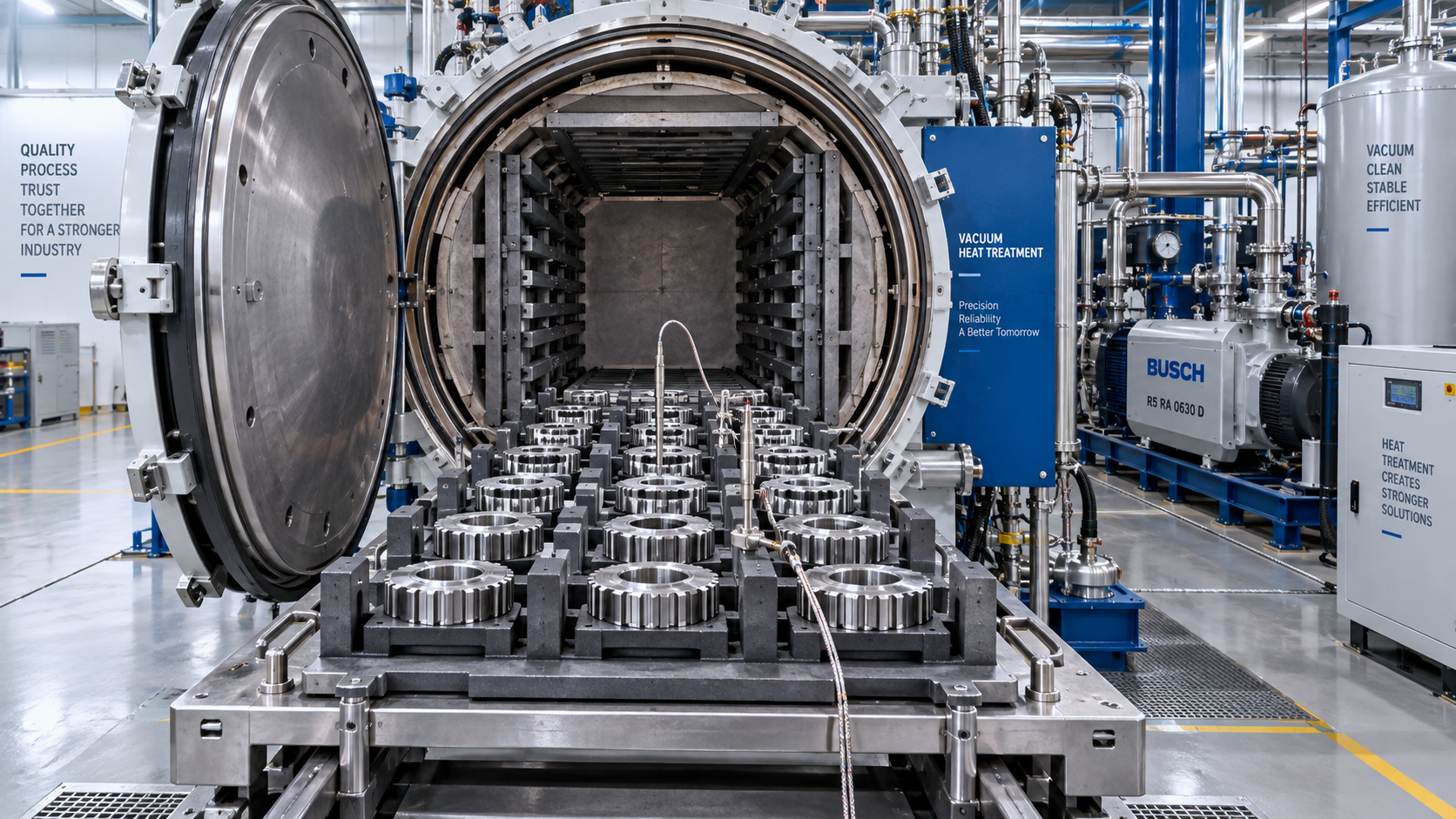
What should be included in a heat treatment supplier audit? For vacuum processing, the audit should establish whether the supplier can repeatedly achieve the required material properties, dimensions, surface condition, and traceability on your actual parts. That means examining furnace qualification, temperature measurement, vacuum integrity, recipe control, loading practices, quenching, inspection, and the handling of process deviations.
A quality certificate and a furnace specification sheet provide useful background, but approval needs evidence from production. The most revealing approach is to select a completed job and follow it from incoming material identification through processing, testing, and release. Each stage should connect to a defined requirement and a retained record.
What requirements should be established before the audit?
Start with the part and its intended treatment. Vacuum hardening, annealing, brazing, solution treatment, and low-pressure carburizing create different audit priorities. A supplier qualified for one process or material family may need additional qualification for another.
Prepare a requirements list covering the material specification, drawing revision, treatment specification, required properties, dimensional limits, surface acceptance criteria, and documentation. Include restrictions on reprocessing, permitted testing methods, and any customer approval requirements.
Identify which standards apply through the purchase order, customer specification, or contractual flow-down. General quality-system certification does not establish compliance with every heat treatment requirement. Where special-process accreditation is required, examine its scope, site coverage, and relevance to the work being purchased.
Before the visit, request:
- The proposed processing route and equipment identification.
- Relevant furnace qualification, calibration, and maintenance records.
- A representative completed job package with its original process data.
- Applicable work instructions, inspection plans, and operator authorization records.
- Recent nonconformance records and corrective actions relevant to the proposed process.
This preparation lets the audit focus on whether controls work in practice, rather than spending the visit collecting documents.
How should furnace capability and qualification be checked?
Check the specific furnace proposed for production. Its operating temperature range, qualified working zone, load capacity, vacuum capability, and cooling system must suit the process. Also examine hot-zone construction: graphite, metallic, and other furnace environments can affect contamination risk and compatibility with particular materials.
The qualified working zone is especially important. A chamber may physically accommodate a component while placing part of it outside the area demonstrated to meet temperature requirements. Fixtures, baskets, and production loads must fit within the qualified boundaries.
Review temperature uniformity surveys and system accuracy checks where the governing specification requires them. A temperature uniformity survey assesses variation across the defined working zone. A system accuracy check evaluates the installed measurement system against a suitable reference. These address different sources of error; one cannot automatically substitute for the other.
Look beyond a passing result. Examine survey configuration, temperature coverage, sensor locations, acceptance criteria, and the response to failures. Check whether repairs, control changes, or hot-zone modifications received the required assessment and requalification.
A qualification report supports only the conditions it covers. It does not automatically establish that every loading arrangement, operating temperature, or cooling cycle will produce acceptable parts.
What evidence demonstrates reliable temperature and recipe control?
Ask how the supplier translates the treatment specification into an approved recipe. The recipe should define the relevant heating stages, soak conditions, vacuum or gas conditions, cooling stages, and any subsequent tempering or aging operations.
Soak timing deserves close attention. Furnace temperature reaching a setpoint does not necessarily mean a heavy component has reached the required temperature throughout. The supplier should have a justified method for determining when the soak begins, using load thermocouples where required or an established method appropriate to the process.
Examine thermocouple selection, placement, calibration, identification, and replacement controls. Sensors experience deterioration in service, so the audit should assess compliance with applicable usage limits and internal procedures. Recording and control instruments also need suitable calibration and traceability.
Recipe access should be controlled. Determine who can create, approve, edit, and select programs, and how revisions are recorded. Compare the approved recipe with the actual recorded cycle. A correct program name is insufficient if an operator can change critical settings without authorization or a retained record.
How should vacuum integrity and contamination risks be assessed?
Vacuum performance involves more than the lowest pressure a furnace can achieve when empty. The relevant question is whether it maintains the required conditions during the production cycle, with the intended load and at process temperature.
Review pump-down behavior, vacuum gauge suitability and calibration, pressure records, and leak-check practices. Leak-rate testing should follow a defined method because pressure rise can reflect both leakage and gases released from internal surfaces. The acceptance criteria must suit the equipment and process requirements.
Inspect door seals, feedthroughs, pumping equipment, and maintenance records. Repeated deterioration in pump-down time or pressure stability should trigger investigation rather than become an accepted operating habit.
Contamination control should cover incoming cleanliness, handling, fixtures, furnace residues, and compatibility between successive jobs. Oils, moisture, cleaning residues, and unsuitable fixture materials can affect surface condition or chemistry. Vacuum processing does not guarantee that every alloy will retain its intended surface composition under every combination of temperature, pressure, and time.
Where backfill or quench gases are used, examine gas identity, specified purity, supply controls, and moisture or oxygen limits where applicable. Acceptance should rely on defined controls and appropriate inspection, rather than surface appearance alone.
Why do loading and quenching need separate scrutiny?
A furnace can hold temperature correctly while the load heats or cools unevenly. Part spacing, orientation, section thickness, basket design, and fixture mass influence the result. Ask for approved loading instructions and evidence that the proposed arrangement represents production conditions.
For gas quenching, pressure is only one part of capability. Gas type, circulation, fan operation, heat exchanger condition, load density, and component geometry influence heat removal. A high pressure rating alone does not establish that the furnace can harden a thick section adequately.
Review cooling records and qualification evidence for comparable materials and section sizes. Where the specification requires cooling-rate control or measurement, verify how it is demonstrated. If oil quenching is used, examine transfer control, oil condition, temperature, agitation, and the relevant operating safeguards.
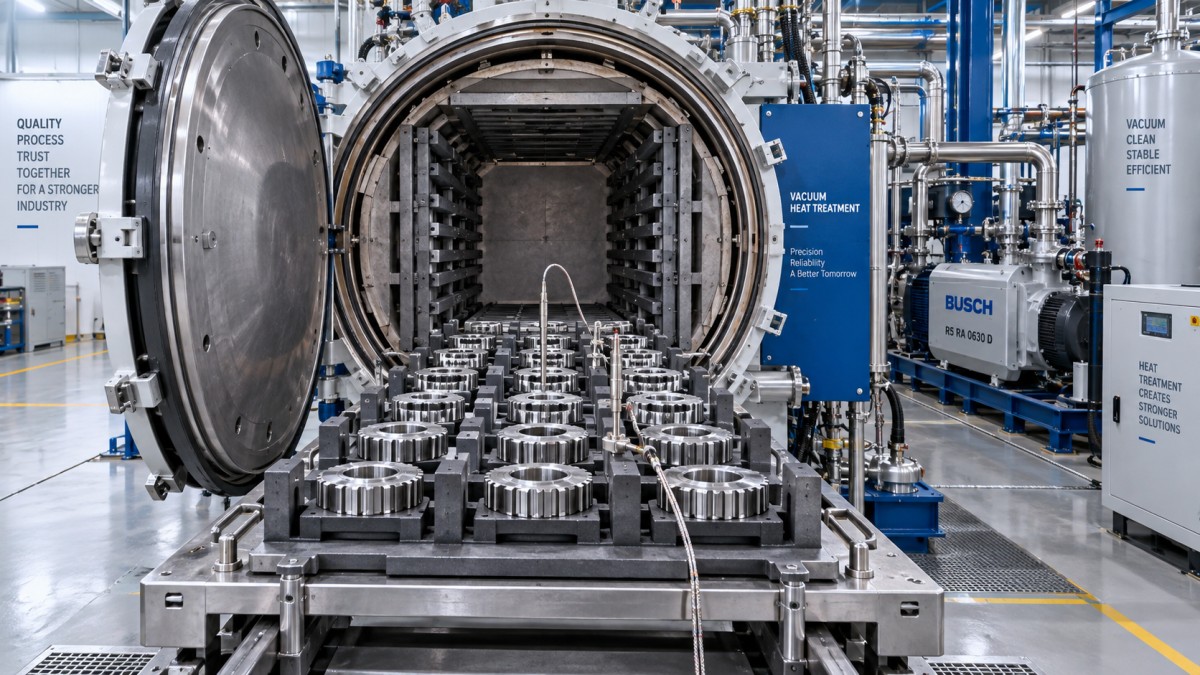
For distortion-sensitive parts, connect loading and quenching practices to dimensional results. Fixtures may improve support while also changing heating or cooling behavior. An acceptable loading method should demonstrate the required combination of properties and geometry.
Changes in batch size also matter. A small trial load may cool differently from a densely packed production load. Approval should define the demonstrated loading range rather than assume that all loads within the furnace weight limit are equivalent.
How can traceability be tested during the audit?
Select a finished batch and ask the supplier to reconstruct its history. The records should link incoming part identification, material or heat identification where required, quantities, process instructions, furnace and load identification, operator activity, inspection results, and release documentation.
Then work in the opposite direction: select an incoming lot and follow it through processing. This can reveal weaknesses in split batches, partial shipments, mixed loads, and parts whose original markings are removed during preparation.
Check how identity is maintained physically. Labels, travelers, containers, and position maps should remain reliable through cleaning, loading, unloading, and inspection. Placing similar-looking parts together creates a preventable mix-up risk when identification controls are weak.
Digital records need controlled access, retention, backup, and a record of relevant changes. If process charts can be overwritten or detached from the job record, the supplier may struggle to demonstrate what occurred. The release certificate should accurately summarize the completed work and reference the applicable requirements.
Which inspection results prove the treatment was successful?
The inspection plan must match the possible failure modes. Hardness testing may support acceptance, but it does not alone demonstrate correct microstructure, case depth, surface chemistry, or dimensional stability.
Depending on the process, evidence may include hardness, microstructural examination, case-depth measurement, mechanical testing, dimensional inspection, surface evaluation, or specified nondestructive testing. Verify that methods, sampling locations, acceptance limits, and testing frequency follow the governing requirements.
Test coupons need particular scrutiny. Their material, size, location, and thermal response should provide meaningful evidence about the production load. A thin coupon that heats and cools quickly may not represent a thick component. Coupons also cannot demonstrate the dimensional behavior of every part.
Check measuring equipment, laboratory capability, personnel authorization, and controls for subcontracted testing. Results should remain linked to the relevant load. Repeat testing after an unexpected result needs a documented basis; it should not become a way to select a passing value while disregarding the original failure.
What should happen when a cycle goes wrong?
Ask the supplier to explain a recent temperature excursion, vacuum alarm, interrupted quench, or failed inspection. The response should include containment, technical assessment, disposition authority, and any required customer notification. A deviation should prevent routine release until an authorized decision is documented.
Reprocessing requires special attention. An additional thermal cycle can affect dimensions, grain structure, surface condition, or final properties. It should follow the applicable specification and approval route, with the full process history retained.
Review whether corrective actions address causes. “Operator retrained” may be appropriate, but it is incomplete when the underlying issue is unrestricted recipe editing, unclear instructions, a failing sensor, or an unstable cooling system. Look for evidence that the correction prevented recurrence.
Maintenance and continuity arrangements also belong here. A backup furnace should have its own demonstrated suitability. Moving work during a breakdown must respect equipment qualification, process validation, and customer approval requirements.
Which findings should delay supplier approval?
Approval should be delayed when the supplier cannot demonstrate control of a requirement that materially affects acceptance. Examples include:
- Missing or expired qualification for the proposed furnace and operating conditions.
- Unexplained differences between approved recipes and actual cycle records.
- Missing load identification or incomplete links between processing and test results.
- Uncontrolled recipe changes or undocumented reprocessing.
- No relevant evidence that the proposed load achieves required properties and dimensions.
- Release of affected parts before process deviations have been dispositioned.
Other findings may justify conditional approval when containment is effective and contractual requirements permit it. Distinguish an administrative omission from a missing technical control: a formatting error and an absent quench record have different consequences.
How should the audit lead to a clear approval decision?
Record each finding against a requirement, identify the affected process or equipment, and state what evidence will close it. Avoid vague actions such as “improve documentation.” A useful action specifies the missing control and the demonstration needed to establish its effectiveness.
Define approval by site, process, material family, equipment, and any relevant loading or operating limitations. For demanding applications, a representative trial can connect furnace records with metallurgical and dimensional results. That trial should reflect the planned production arrangement.
The final decision should answer a practical question: can this supplier demonstrate a controlled route from the specified material to acceptable finished parts, and maintain that control when production conditions change? Approve the capability supported by the evidence, with clear triggers for reassessment after significant equipment, recipe, loading, or subcontracting changes.
Expert Insights

Chief Security Architect
Dr. Thorne specializes in the intersection of structural engineering and digital resilience. He has advised three G7 governments on industrial infrastructure security.
Related Analysis
- Nov 01, 2026Choosing a Biosafety Cabinet for Microbiology: Class I, II, or III?Author :Dr. Aris Nano
- Oct 31, 2026Pallet Truck Scale Prices: What Affects the Cost of a Weighing Pallet Jack?Author :Dr. Aris Nano
- Oct 30, 2026How to Use a Concrete Test Hammer to Assess Concrete StrengthAuthor :Dr. Aris Nano
Recommended News
- Choosing a Biosafety Cabinet for Microbiology: Class I, II, or III?Author :Dr. Aris Nano

- Pallet Truck Scale Prices: What Affects the Cost of a Weighing Pallet Jack?Author :Dr. Aris Nano

- How to Use a Concrete Test Hammer to Assess Concrete StrengthAuthor :Dr. Aris Nano

- Metal Joining Services in Southeast Asia: How to Qualify SuppliersAuthor :Marcus Valve